Thursday, September 09, 2010
Stand up comedians
Following his progress from up-and-coming star on TV and stage, to despair with the profession, back to his triumphant return to comedy (said in best Krusty the Clown voice), the book contained the three transcripts from each of Lee's three most recent stand up shows, with footnotes littered throughout explaining the origins of certains jokes, references being made, or asides to other comedians.
This was the most interesting aspect of the book, hearing Lee explain in detail, often over a page in small, footnotey font (why is footnote font so small?), about his time working with Harry Hill and Robin Day, or explaining that he bought a certain joke from another comedian to help lighten the mood of his otherwise often long-winded affairs.
Reading his scripts without knowing the delivery would give you no clue as to how funny Lee can be, the way he repeats jokes over and over again, with changes throughout perhaps, to build laughter from what could be awkward repetition. Or that, as Lee admits, sometimes is just awkwardness and the audience fails to get the delivery and therefore the jokes.
A final point on the book I found interesting, was Lee's choice of introduction music for his shows.
For each one he used piece of jazz to help him identify, or even turnaway, potential troublemakers: "If they can't handle the music, they probably won't like the show" is Lee's (paraphrased) rationale behind this and certainly one that seems to make a lot of sense.
Overall then, if you're a fan of the man and want to know more about the thought processes behind his shows and the world of interesting, clever, thought-provoking comedy, this book is one for you.
I give it 41/100.
Tweet
Friday, September 03, 2010
Echoes
This clip of Neville Chamberlain announcing war between Germany and the United Kingdom in 1939, some 71 years ago, is very moving, profound and interesting. Worth a long listen to for such lines as, "Hitler would not have it" "I know you will all play your part with calmness and courage", and of course, "this country is at war with Germany".
Monday, August 23, 2010
Public Squeaking.
This weekend I was at the wedding of two very good friends from university and they kindly asked me to read First Sight by Phillip Larkin at the service. I decided I would learn it by heart in order to give the best performance I could and, thankfully, it went fine: I stood, I poetried, I sat again. Phew.
It was strange, though, having to learn something word perfect, for possibly the first time ever, to deliver as impeccably as possible. The best man, groom and father of the bridge speeches must all be scary and exciting too, but at least you can ad lib, or um and err your way through them. For poetry, you have to get it perfect, everytime (talking widely here now, not about myself).
Anyone else done a poetry reading / recital? I might try The Waste Land next…
'This music crept by me upon the waters
And along the Strand, up Queen Victoria Street.
O City city, I can sometimes hear
Beside a public bar in Lower Thames Street,
The pleasant whining of a mandoline
Saturday, August 14, 2010
Is Billy Joel any good?
Growing up, driving around in a black, weather faded Renault, then a highly economical Passat, my parents subjected me and my brother to many a songsmith, from Bob Dylan to Clapton to, you’ve guessed it from the title, Billy Joel.
Years later and my love of Dylan is strong, Clapton, meh, and Billy Joel…well, I just don’t know. Some of his stuff is overblown tripe, I think, but other songs seem deceptively good, I think.
It doesn't help that songs like Uptown Girl have moulded his reputation in the general consciousness (mostly probably mis attributed as a Westlife song too I would bet) and he seems to have this vague air of “ha, Billy Joel? Don’t make me laugh…” A sentiment my brother and I both developed as we grew up but that now I think we would both admit has passed into grudging respect, even enjoyment.
A song like Piano Man is the very model of a genuinely good pop hit. Melancholic, rousing, reflective, engrossing, uplifting if you wish, downbeat if that’s your mood, it's up to you.
Goodnight Saigon is a damning reminder of the pointless waste of the Vietnam War, complete with dramatic helicopter sound effects and a huge military chorus of “We will all go down together”. It’s actually kind of heartbreaking.
We Didn’t Start the Fire is an incredible piece of showmanship, even if some of the rhymes are a bit forced. Yet again, it’s also sort of laughable when you hear it too many times. It’s certainly ripe for parody too.
Then we come to Scenes from an Italian Restaurant. A seven minute plus pop epic that starts with a slow, almost saccharine love song chorus then randomly shifts into a fast, three-line stanza-ed rock song complete with madly upbeat clarinet work, trumpet solos and jaunty piano fills and trills that all flit around a song about the “popular steadies Brenda and Eddie” realising their love isn’t that strong and falling apart. It’s bizarrely epic and inappropriately upbeat.
Also, a lot of Joel's lyrics actually make sense. Someone like Elton John is a clear example of a similar type of musician (broadly speaking), yet some of his Bernie Taupin's lyrics are scandalous: "Mars ain't the kind of place to raise your kid, in fact it's cold as hell...and there's no one there to raise them, if you did". What the hell does that mean? Sheer nonsense.
Yet rarely, if ever, does Joel ever seem to feature in any Top 100 this, or Top 50 that lists. I feel this is an oversight. Although they did make a stage musical of his songs. Which is something. Also, we share the same birthday. So that’s nice.
Any response to all these musings? Good, bad, indifferent? Well?!
Thursday, August 12, 2010
Around the coast
Britain is a coastal country. This is well known. You can rarely be more than 50 miles from the sea. For some people in some countries the idea of being 50 miles from the sea would be as good as being on the coast.
One man, Nat Severs, is, as I blogged before, currently walking the entire coast of the UK at the moment. That’s 7,000 miles. A long way. He’s now heading south, after many months of northward walking, in and out of the endless inlets of the west coast of Scotland, and eating up the miles as heads back to the starting point of Portsmouth, where he began on January 10. It’s all massively impressive and if you want to know more, then go to his website and read more. Most impressively, have a look at the map of his journey and see each individual days walking he did.
Complementing this blog I am here writing at this very moment, is a book I recently read by another previously blogged topic, Paul Theroux, in which he travels around the UK coast, not as literally as Nat, but close enough, following the same clockwise route through walking, buses and, of course, trains. I read it last week as I rattled home on the First Great Western train to Truro out of Paddington, at one point, always the best bit, passing the sea, mere waters from the sand filled with walkers, dog owners nad fisherman. It seemed very apt to be reading of his trip around this very coast some twenty five years earlier when Britain was at war with Argentina.
Theroux’s trip is marked with heavy sarcasm, almost resentment of the places he sees, not always, but often, and his distain for the UK holiday industry of Butlins and the like, of people in box cabin caravans in fields is clear throughout. He sees no better future for the UK coastal future, predicting a continuation of such drab, bleak holidaying of citizens enjoying cheap, regimented fun.
Yet, he was wrong. The UK coast now is fancy, expensive and much sought after. I’ve seen my home town turn from a sleepy sea side place to a growing tourist trap filling slowly with the same chain stores as anywhere else, Costa, Nero, FatFace, and the like. Yes, some areas are untouched by this gentrification, but many are not, and it’s interesting to think that in the 1980s as Britain was a drab, soulless place (through Theroux’s eyes) that seemed to be falling into further disrepair, it has now become home to the likes of Rick Stein filling towns like Padstow and Falmouth with expensive fish and chip shops, growing numbers of arts festivals based around the water and shoreside apartments used by city workers for two weeks a year, if that.
It's interesting to imagine the various futures that people imagined in store for Britain throughout the 1980s, or before, as we do now. Where we imagine, perhaps, failure, continuation of stagnation, it can offer be quite the opposite.
The enchanted kingdom of McDonalds
Never before had she seen such splendour, or such ornate decorations and furniture, her face seemed to say.
After she had stopped and taken in the sumptuous surrounding she slowly stepped forward, as if scared of shattering the dream she had wandered in to by stepping to heavily. She craned her neck up in wonder at the ceiling, as if Michelangelo himself had painted them.
Then suddenly it was too much. She went outside again, stared up in disbelief at the giant M outside.
"Could it be," she wondered. "Is this really what a McDonalds is? My parents had told me they were evil, dirty, downtrodden places where the masses come to fritter their finances on fries and milkshakes."
She stood still, wondering what to do next. Then, strangely, she left. Turned tail and removed herself from the scene, and tramped off into the rain. I looked around. No-one else seemed to have noticed this strange creature so enraptured by the place.
I continued chomping, sent a text, received a text, texted back. In this time I never noticed she had returned. She sat this time, wearing dark sunglasses, at the end of the long formica bench I was sat on, as if she was the coolest girl in the world because she had found a McDonalds.
She was an odd one, no doubt about it. I wonder what her reaction would have been if she'd had any food. She may have exploded.
Post this to Twitter
Monday, August 02, 2010
Some film thoughts
A lazy, lazy Sunday (in which my main activity was a walk to the local Oxfam book shop where I bought The Kingdom by the Sea for £2.50), was complemented by a few films watched.
Johnny English. Is this film good? I can't decide. I've seen it before, of course, and only watched the last 45 minutes of this before I headed out (as mentioned, lazy day, hungover and very tired from much sport playing on Saturday). It's sort of funny, and Malkovitch is brilliantly over the top . But then some of it is so over the top and stupid and obvious that it seems quite lazy. I guess it doesn't matter really.
Brighton Rock (original). I thought this was terrible. I know it's from a loonnnggg time ago (maybe 50 years!) but I just didn't get it. There was so much random cackling from characters, often weirdly out of sync with their lips (it seemed to me), the acting was mostly pretty lame and I still don't buy the plot (book or film) of lame thugs and stupid girls. The remake is out later this year, so I look forward to seeing if that makes an improvement.
Frequently Asked Question about Time Travel: Strange one this. Some of the plot was quite clever and nicely linked together, but then again some of the piece were really stupid ( the future party of people dressed like them / the "editors" who come back and kill people). A pretty cheap film, the kind of film that in 30 years will have the same heavily dated, cheap British film look that 1970s films have to us know.
Also, I finished Birdsong last week. I enjoyed it, but also thought it was a touch overrated. It has such a high standing in literature from the last twenty years, and Faulks is seemingly so revered, but I found the writing pretty average, but in a good way. It wasn't bad, but I had imagined it to be better. Still, it was a strong narrative, but then again anything about WWI is always moving. It really was the most ridiculous war, in which human's really did show their innate stupidity through and through (at least from behind the front lines). I digress.
Tuesday, July 27, 2010
Sher locks Homes
Sherlock Holmes, Sherlock Homes, Lock Homes. Most fictional detectives’ names make a play on the ideas of security, or their personalities. Morse (code), Creek (up without a paddle), Frost(y) personality…er…well, it does fit in some cases - an old theory from an university lecturer...
As a big fan of Jeremy Brett’s Holmes (definitive) I was interested to see the new adaptation on Sunday on the Beeb. It was indeed very good. I particularly the rift on “three pipe problem” into “three patch problem”. Modern.
There was also some nifty smartphone’s interaction, which was, well, even more modern. You can't beat the idea of someone very smart, working everything out very quickly from the facts, like, and brow beating those around him. I think we all like to imagine ourselves as a bit like that, as a slight git who calmly, unshakably brings order to a situation. But we aren't like that, are we?
The plot was a bit manic, but it was set up well for the next two episodes, (liked the idea of Mycroft as a government stooge). London looked nice too, including the dirrrttttyy streets of Soho, and it'll be interesting to see whether the next two episodes keep up the popularity the show has had so far from critics and twitter people so far (my yardstick anyway).
Obligatory use of the word elementary in a piece about Sherlock. Although he never said "elementary, dear Watson", instead saying, "elementary".
Tuesday, July 20, 2010
Thoughts on returning from Latitude
There are many mediocre comics in the world: The comedy tent is always a good place to stop by and enjoy some, well, comedy, but this year there seemed to be a blight of utterly mediocre and downright boring comics on the stage. So many just churn out anecdotes “I swear this is true”, that aren’t really that funny, or just endlessly talk about their “embarrassing sex life” that it was quite painful to watch at times.
The winner of the young comic of the show award (name escapes me), did nothing but silly voices, terribly improv and even “I pretend to be French when approached by charity muggers! I’m mad I am!” It was awful.
And another thing, so many of them say, “I’m such a geek!”, as if this is what makes them so uniquely comic, but the thing is, we’re all geeks now. We all like Twitter, Facebook, all discuss mobile contracts, network coverage, our phones capabilities, we all look at random stuff on the internet, and all these other various things they think make them geeks (more or less). Stop saying it to endear us too you.
Also saw Josie Long doing some comedy musings in the literature tent on Saturday night, which was also pretty terrible. Just because someone is cute and whimsical doesn't mean what they say is funny, and the stuff she did was almost cringeworth. (A cartoon picture of Nye Bevan talking in a mad, screechy voice).
Saying all this, David O’Doherty on Friday afternoon was probably one of the funniest live comedy I’ve ever seen.
Musically, some bands I saw I hadn’t heard before but enjoyed were Chief, Schools of Seven Bells, and Midlake and also Temper Trap were surprisingly enjoyable. Saw lots of other bands, but these stuck in the mind most. Flo was good, but a tad over long, Vampire Weekend quite enjoyable, and Belle and Sebastian predictably cute and nice, but also fun and worked well for the festival’s vibe.
Sebastian Faulks is such a cliche of the quiet, well spoken, thoughtful English novelist it's unreal, but he is also interesting, so that saves him.
Although the news of what happened at the event was terrible I saw nothing bad happen anywhere else on the site of any description, and thought the security was as reasonable as necessray, i.e. not heavy handed or over the top, but suitably present at relevant points. But then again, after what happened, I'm probably wrong.
My hatred for festival food (over priced, bland, tasteless, and unfulfilling), got another layer of disgust this time when I got some mild poisoning during Saturday (from a burger or noodles, not sure), and was promptly ill later that night. Joyous.
Overall though, a fun weekend.
Monday, July 12, 2010
Staggering
I experienced my first one this weekend. It was fun. It involved some beaching and footballing, and best of all some clay pigeon shooting (men eh?), and copious alcohol in between, as to be expected.
All this took place in the delightful surrounds of Bournemouth, a slightly terrifying seaside town, where an undercurrent of simmering violence and sexual frenzy felt ready to burst at every minute, perhaps explaining the proliferation of sex-chat cards in the town, more than I've ever seen anywhere in my life.
It was, as stated, fun, but the idea that I could potential go on 10 more of these, spending a lot of money each time, and possibly having to go abroad too, fills me with a vague sort of dread and ennui, but then, that's probably true of lots of things.
We stayed in a Premier Inn, it was surprisingly good.
Wednesday, July 07, 2010
The Jim Beglin Phantom Voice Syndrome
Last night, during Holland's 3-2 win over Uruguay in the World Cup (a Football Manager style result if ever there was one) commentator Clive Tyldesley was forced to go without his commentating mate Jim Beglin, who was ill.Strangely, ITV had no replacements for him, so Clive was alone, a single voice talking to the millions back at home (or possibly no-one at all). Even stranger, though, than this decision, was the fact that despite Beglin not being there to chip in with agreements or further "insights" I could still hear want he would have said.
Example, say a close offside, Tyldesley would say something like, "That's a tight call by the linesman", and there'd be silence. But I'd hear Beglin, in those dusky, back of the throat tones adding, "Oh, you know I think the linesman's got that one wrong Clive". I imagine many other viewers suffered from the Jim Beglin phantomn voice syndrome throughout the game too. Perhaps ITV were banking on this?
It worries me that I have, by only the age of 25, heard so many of Beglin's phrases when he is sat next to Clive for all those Champions League games, that my brain can conjure up his voice and his phrasings itself.
Anyone else get this sensation during the game?
Tuesday, July 06, 2010
More books
Ever After by Graham Swift. Having thoroughly enjoyed Waterland (recommended, highly) I noticed this book in my local Oxfam for £2 and splashed out. It was definitely worth it – a sad, somber, reflective book on life, art, religion and death, it covered the life of a university tutor, knowing he is something of a fraud, ruminating on the death of his wife, his mother, his step-father, and at the same time, researching an ancestor's fall from grace as he came to question the existence of God in the 1850s. Moving, well-written stuff.
The Noughties 2000-2009: A Decade That Changed the World by Tim Footman. A supposed reflection on the 2000s, this book was really little more than a list of different ways a theme of the decade was interpreted among the art world (X wrote book Y, Z produced film A, after event T and so on (can I use other letters like that?)), and the bare facts around the events of the decade – 9/11, global warming, globilisation, war on terror, financial collapse. Only the chapter on shopping, which contained some stomach turning quotations from a chief of Starbucks about why people go to Starbucks (i.e. for the 'experience maan'), was particularly illuminating
The English Patient – Michael Ondaatje: Possibly more famous from the film (that I've not seen, but may seek out now) this was a highly-lyrical and interesting novel set in Tuscany (where I was, how apt), at the end of WWII, detailing four strange individuals thrown together in a crumbling Italian villa, and their interactions with one another from shared pasts, and possible futures. Some very clever and original set pieces, and character back stories made the book very interesting, but the ending felt a tad rushed, a bit too instantly dramatic, when one character suddenly loses his sense of purpose on hearing of the atomic bomb drops in Japan. Still, worth reading.
Any thoughts on any of the above most welcome.
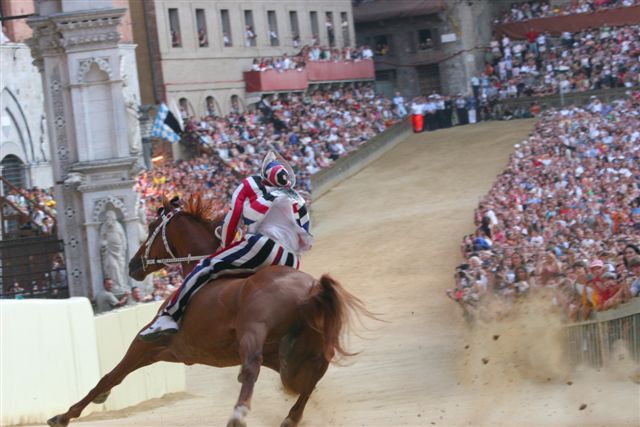
Horsing around in Italy
I was in Italy for the last few days. I saw the Palio in Siena, which was truly spectacular. Three laps of the Campo around which ten horse riders, from 17 of the cities districts or Contrada ride barebacked, in a mad race to be victorious for their people.The emotions on display where utterly raw, with tears of despair and joy on the faces of all those involved, the winning jockey paraded aloft after the race, and celebrations going on past 3am (when my friend and I gave up for the night…)
For days up to the event there is singing, parades, singing, horse-blessings, singing, and practice Palios, all making for 70 seconds of sheer drama and excitement.
Siena itself, Palio or not, is also a spectacular place, full of narrow cobbled streets and towering walls where shops and houses intermingle with ramshackle brilliance.
From there we went to Florence, where it was 35 degrees without a breath of wind which was almost unbearable, but we still took it all in. A lovely place, no doubt, but a bit more touristy than Sienna and probably mostly doable in two days.
We flew Ryanair, but in truth it was absolutely fine: what'd you'd expect for flights to Europe and back for £60. No service to speak of, but just take off and landing, all you really want from a two hour flight. When we landed in Pisa they played an celebratory trumpet burst (over the speakers, not the captain himself), which was a bit of fun. Because it is worth celebrating a landing, is it not?
Monday, June 28, 2010
Moving lives
All someone's worldly goods packed and pressed away into the boot of a car, all to only be unpacked and repurposed in a new location. Cavemen must have done the same.
In other news, I finished Wolf Hall on Sunday. Took me five weeks to read it (admittedly with a break to read an Orwell book I was reviewing in between). It was an enjoyable book, but also required absolutely concentration: so detailed, and so full of voices was the book that a moments idle wanderings of the mind and speaker, time, location could all change in an instant, leading to utter confusion for the reader.
Still, it did help remind me what a fascinating bunch of people the Tudors, and the ilk were, all intrigue, rumour and affairs and the desperate desire for male heir (it's almost banally ironic that after Henry VIIIs six wives, all in the attempt to bring him a son, it was his daughter, by Anne B (who was executed for basically not giving him a son) who would become the saviour of England) as well as hideous forms of death they had for people considered traitors, who just a few months before could be receiving the highest praise from all of Christendom.
Would I recommended the book? Well, no, but I wouldn't not recommend it either: it's up to you.
I have moved on to Ever After by Graham Swift now, he of Waterland and Last Orders fame, and it's already very enjoyable.